Choosing between a mid-century modern TV stand and a built-in media console comes down to one question: do you want furniture or architecture? A freestanding credenza on tapered legs moves with you, needs no construction, and brings instant character to a living room. A built-in media console is fitted to the wall, hides every cable, holds far more, and becomes a permanent part of the house. Renters, frequent movers, and anyone who loves a single statement piece usually lean freestanding. Homeowners who want maximum storage, a clean wall, and a TV that looks planned rather than parked usually lean built-in.
At Prestige Cabinet, we design and install Italian-made cabinetry for living rooms, kitchens, and closets across Orange County, so we have an obvious stake in the built-in side of this debate. That is exactly why we want to be straight with you. In plenty of homes, a well-chosen mid-century modern TV stand is the smarter, simpler answer, and our designers say so when it is.
Below, we compare the two on the points that decide the outcome: flexibility, storage, cable management, scale, tip-over safety, materials, and longevity. We also cover how built-ins borrow mid-century warmth, and we close with the questions to ask before you buy or build.
Freestanding Credenza vs Built-In Media Wall: The Quick Comparison
Short on time? Here is how a freestanding piece and a fitted media console compare on the decisions that matter most.
- Flexibility: A freestanding stand can move to another wall, another room, or another house. A built-in stays where it is installed.
- Storage: A freestanding console holds what fits inside one case. A built-in can run wall to wall and floor to ceiling, combining closed storage, open shelving, and display niches in one composition.
- Cable management: Freestanding stands rely on cutouts in the back panel and cords running down the wall. Built-ins can route power and signal behind panels so nothing shows.
- Fit: Freestanding pieces come in set sizes. A built-in is sized to your wall, your ceiling height, and your screen.
- Safety: A freestanding stand should be anchored to the wall, along with the TV on top of it. A built-in is fastened to the structure during installation.
- Commitment: A freestanding stand is a purchase you can undo. A built-in is a renovation decision that should suit the house and, one day, its next owner.
Neither side wins outright: the right choice depends on how long you plan to stay, how much the wall must store, and how the room is actually used.
What Defines a Mid-Century Modern TV Stand?
“Mid-century modern” describes the furniture and architecture of the postwar decades, and the style has never really left American living rooms. A mid-century modern TV stand applies that design language to a piece that is low, long, and built to hold a screen and the equipment around it.
The Design DNA: Tapered Legs, Warm Wood, and Low Horizontal Lines
Most pieces in the style share a recognizable set of traits:
- A low, long silhouette that emphasizes horizontal lines
- Splayed or tapered legs that lift the case off the floor, so the room feels lighter
- Warm wood tones such as walnut and teak, often as veneer over a stable core
- Flat slab doors and drawer fronts with minimal hardware, from recessed finger pulls to sculpted wooden handles
- Sliding doors, slatted or caned fronts, and a mix of closed and open compartments
Many pieces sold as a mid-century modern TV stand are really credenzas or sideboards adapted for electronics, with cord holes added to the back. That heritage matters. A dining room sideboard was never designed around the weight, heat, and wiring of a modern media setup, so the adaptation is only as good as the details behind it.
From Postwar Storage Units to Today’s Media Credenza
The style’s approach to storage was modular and portable from the start. One landmark example, the Eames Storage Unit designed by Charles and Ray Eames, was produced by Herman Miller from 1950 and is now held in the collection of the Museum of Modern Art. Built from plywood, lacquered Masonite panels, and steel, it was a freestanding, modular case intended for postwar households whose storage needs kept changing.
That idea of flexible, furniture-scale storage is what most freestanding mid-century pieces carry forward today. It is also the clue to their limits: they were designed to be moved, not to disappear into a wall.
What Is a Built-In Media Console?
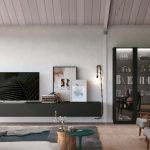
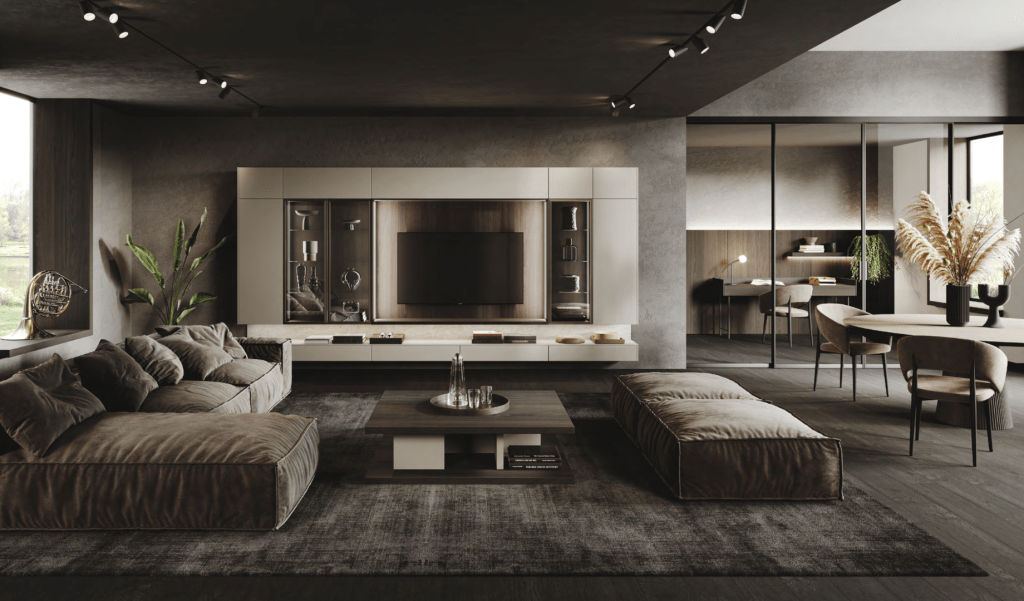
A built-in media console is cabinetry fastened to the wall, and often to the floor or ceiling, and designed around a television and its equipment. It can be as modest as a single run of base cabinets or as ambitious as a full media wall with tall storage, shelving, and lighting. Because it is made to measure, it fills its wall exactly, with no awkward gaps at the ends.
Floating Consoles, Low Cabinet Runs, and Full Media Walls
Built-ins come in three broad forms:
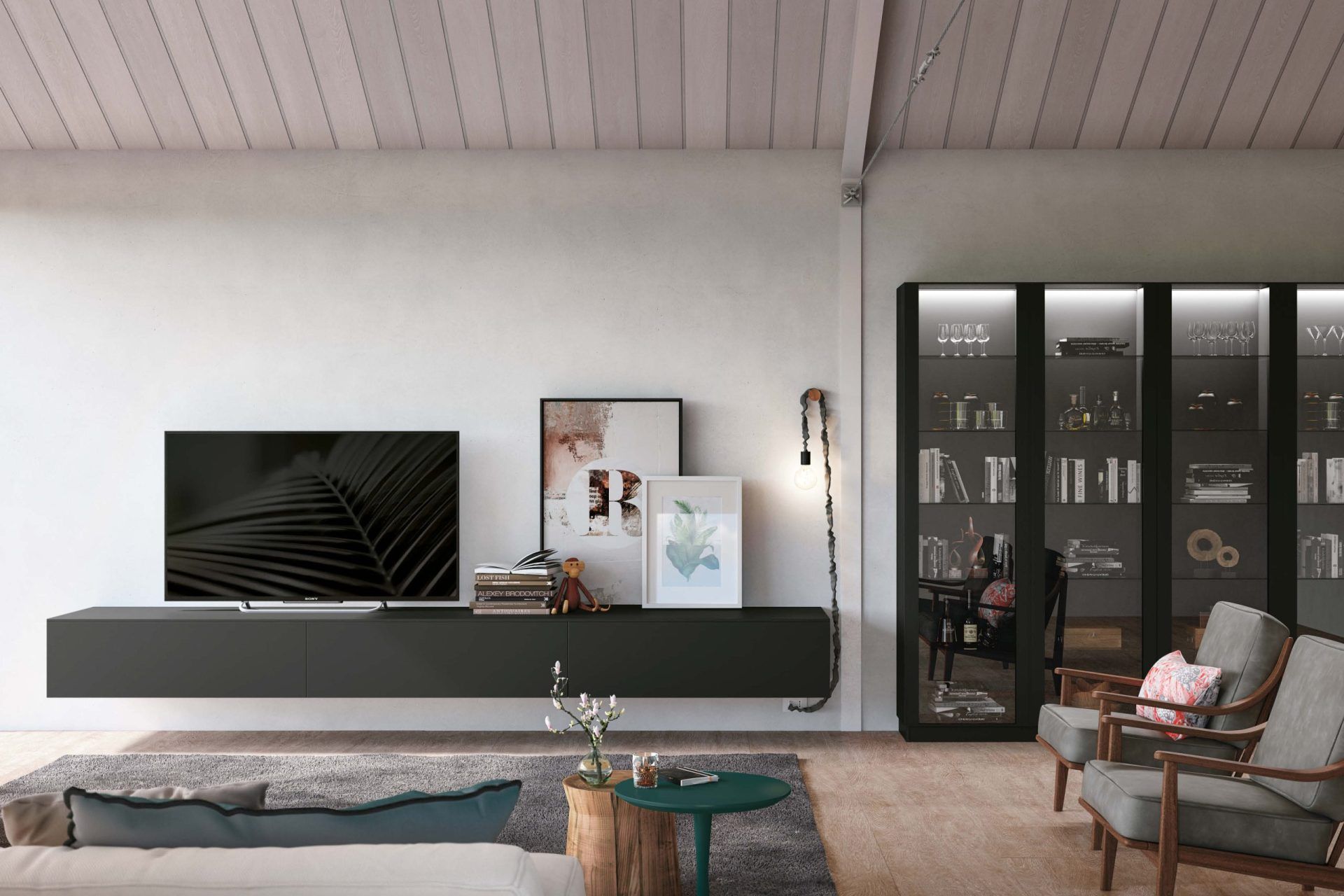
- Floating (wall-hung) consoles: base cabinets suspended above the floor, which keep the floor visible and make a living room feel larger
- Floor-standing runs: a long, low cabinet set on a plinth or slim legs and scribed to the wall, often spanning the full width of the room
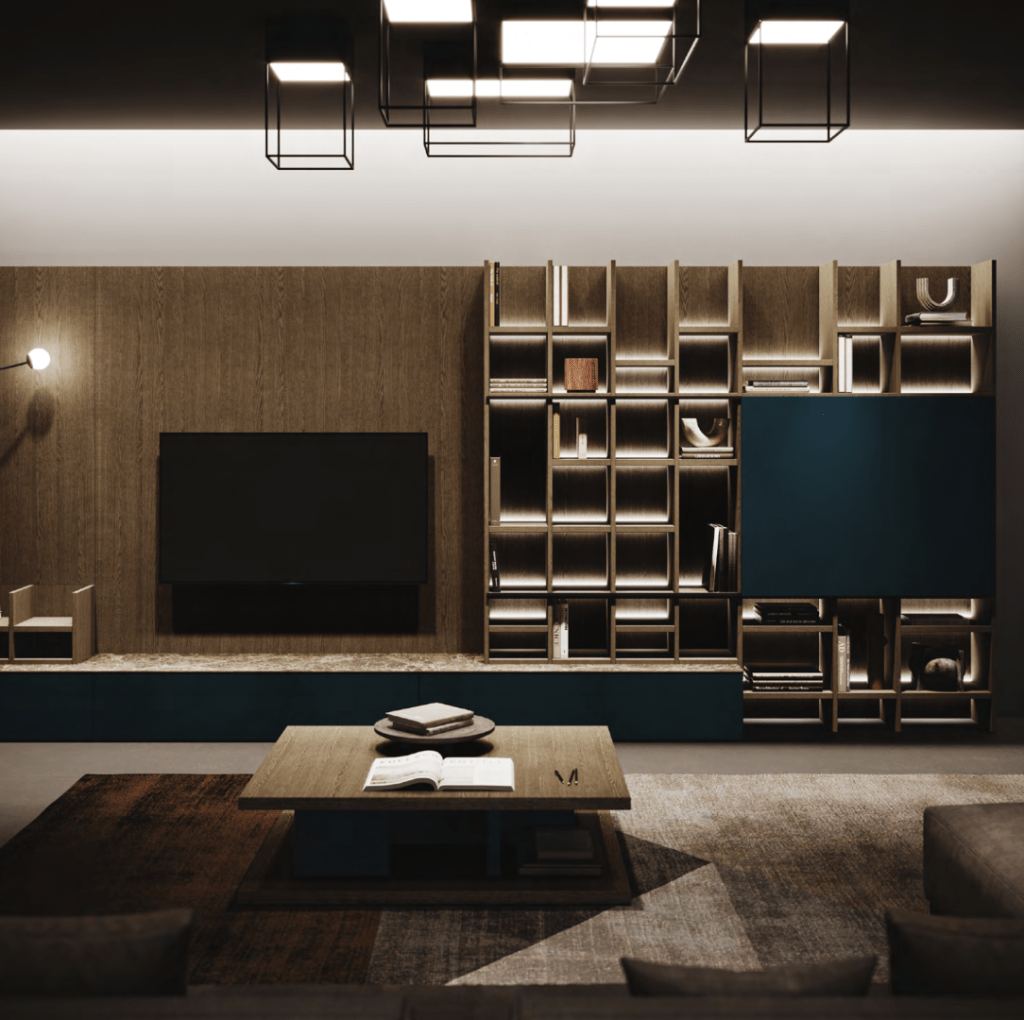
- Full media walls: a base run combined with tall units, wall cabinets, open shelves, or display niches, framing the TV as part of the architecture
How Built-Ins Borrow Mid-Century Character
A built-in does not have to look like a modern kitchen that wandered into the living room. The features that define mid-century furniture translate directly into fitted cabinetry: flat slab doors, walnut or oak wood veneer with grain running continuously across the fronts, slim legs or a recessed base, and handleless fronts or simple wooden pulls. The difference is that the cabinetry is sized to your wall and engineered for electronics from the first drawing.
Freestanding TV Stand vs Built-In: How They Compare Where It Counts
Style gets you into the showroom, but performance decides whether you are still happy years later.
Flexibility, Moving House, and Changing Screens
Flexibility is the strongest case for a mid-century modern TV stand. You can rearrange the living room, take the piece with you when you move, or shift it to a bedroom when you upgrade. If you rent, expect to move within a few years, or simply enjoy rearranging, freestanding furniture keeps every option open.
A built-in asks for more commitment. It should be planned around a screen size you expect to keep for years, with enough room around the TV zone for a larger screen later. Ask your designer how the layout would accommodate the next television, not only the current one. A media wall with an open zone around a wall-mounted screen adapts far better than a tight niche cut to fit one model.
Storage Capacity and Organization
A freestanding console holds what fits in one case: a few drawers, a shelf or two for devices, and perhaps a cabinet for games or records. For many households, that is plenty. If the living room also has to hold board games, books, blankets, and toys, a single piece fills up fast and the overflow ends up in baskets on the floor.
A built-in uses the full width and height of the wall. Deep drawers in the base run hold controllers and spare cables, tall units on either side absorb what would otherwise clutter the room, and open shelves or lit niches give books and objects a place to be seen. Closed storage low and lighter, more open storage higher up is the arrangement that keeps a living room calm. Our room-by-room guide to the types of storage cabinets covers how media walls fit into a whole-house storage plan, and our built-in bookshelves page explains how we keep long shelf spans flat under the weight of books.
Cable Management and Electronics Ventilation
Cables are where many freestanding setups disappoint. With a mid-century modern TV stand, power and signal cords usually run from the TV down the wall and into holes in the back panel, and a cord cover is the best you can do. A wall-mounted screen above the stand leaves a visible run of cable unless the wall is opened up behind it.
Built-ins solve this at the design stage. Cable chases inside the cabinetry, removable back panels, and planned openings let power and signal travel out of sight from the screen to the equipment below. One rule applies either way: power should never be run inside a wall on an ordinary extension cord. A licensed electrician can add a recessed outlet behind the TV or an in-wall power kit made for the purpose.
Heat needs the same attention as wiring. Receivers, game consoles, and streaming devices all produce heat and need airflow, so whichever option you choose, follow each manufacturer’s clearance guidance. Look for vented back panels or open compartments. If you want closed doors, choose fronts that let remote signals through, or use devices that respond to Bluetooth or radio-frequency remotes rather than infrared.
Fit, Scale, and Proportion With Today’s TVs
Scale is a design decision as much as a measurement. A stand that is narrower than the screen above it looks top-heavy, and vintage credenzas, built for a very different era of electronics, are not always as wide as today’s TVs. Before buying a mid-century modern TV stand, compare its length to the width of the screen, and check its rated load against the TV’s weight in the manufacturer’s specifications. Even if the TV is wall-mounted, the console below should read as wider than the screen, so the wall feels balanced rather than stacked.
A built-in removes the guesswork. The cabinet run can extend the full width of the wall, align with windows or a fireplace, and place the center of the screen close to eye level from your actual seating, rather than at whatever height a catalog piece happens to dictate.
Tip-Over Safety and Anchoring
This is the part of the decision that matters most in homes with children, and it is easy to overlook in a showroom. According to the U.S. Consumer Product Safety Commission, 47 percent of the 217 tip-over deaths reported to the agency from 2013 through July 2023 involved a television. The same CPSC report estimates that tip-overs involving TVs, furniture, and appliances send about 17,800 people to hospital emergency departments each year.
CPSC’s guidance through its Anchor It! campaign is direct: anchor TVs and furniture securely to the wall, and if anchoring is not possible, place the TV on a sturdy, low base and push it as far back as it will go. The agency also advises keeping TV and cable cords out of children’s reach.
For a freestanding mid-century modern TV stand, that means two anchors: one securing the stand to the wall and one securing the TV, unless the TV is wall-mounted. Pieces on slim, splayed legs deserve extra care. The federal stability rule that took effect on September 1, 2023, was written for clothing storage units such as dressers, so don’t assume a credenza, and certainly not a vintage one, was designed to it.
A built-in media console is fastened to the wall structure during installation, which removes much of the tip-over risk by design. A wall-mounted TV above it must still be fixed into studs or solid blocking with a mount rated for its weight.
Materials, Build Quality, and Indoor Air
Mid-century style is easy to imitate and hard to build well. Many new stands sold in the style use engineered panels wrapped in a printed wood-look surface, while better pieces use real wood veneer over a stable core with solid-wood legs. Vintage pieces bring their own questions: lifting veneer, loose leg joints, sticking drawers, and a load capacity nobody can confirm.
Whatever you buy new, ask about the panels inside. Under the EPA’s formaldehyde emission standards for composite wood products, hardwood plywood, medium-density fiberboard, and particleboard, along with finished goods that contain them, must be labeled as TSCA Title VI compliant. EPA worked with the California Air Resources Board so the national rule would stay consistent with California’s requirements. A reputable furniture seller or cabinet maker should be able to show you that label.
Built-ins face the same question. At Prestige Cabinet, we specify materials that comply with both CARB and TSCA Title VI, and we build living room cabinets to the same standard as our kitchens. For a closer look at what separates a well-built cabinet box from a look-alike, read our honest comparison of European cabinets vs American cabinets.
Longevity, Resale, and the Next Owner
A well-made mid-century piece can last for decades and follow you through several homes, which is a genuine argument for investing in quality freestanding furniture.
A built-in’s value is tied to the house. Well-designed built-ins that suit the architecture can read as a feature to future buyers, while a heavily personalized media wall built around one specific screen can start to feel dated sooner. Keep the design timeless, leave room for a larger TV, and coordinate finishes with the rest of the home, and the cabinetry will age with the house rather than against it.
When a Mid-Century Modern TV Stand Is the Better Choice
A freestanding piece is usually the right call if:
- You rent, or expect to move within a few years
- You already own a vintage credenza you love, or you are hunting for one statement piece
- Your wall space is limited, with windows, doors, or a fireplace leaving no clean run for cabinetry
- Your storage needs are modest: a few devices, a soundbar, and some media
- You like to rearrange furniture, or you expect the room’s role to change
- You want the warmth of the style without any construction work
If you go this route, anchor both the stand and the TV, check the load rating, and plan the cable path before the TV goes up.
When a Built-In Media Console Makes More Sense
A built-in usually earns its place when:
- You own the home and plan to stay
- The living room has to store far more than electronics, from books and games to blankets and toys
- You want no visible cords, with power and signal routed out of sight
- The wall is awkward: an alcove, a sloped ceiling, a fireplace to frame, or a run no catalog piece fits
- The living room opens to the kitchen, and you want the cabinetry in both spaces to coordinate
- Young children live in or visit the home, and you would rather have storage that is fastened to the structure
In open-plan homes, coordination is often the deciding factor: one cabinet maker for the kitchen and living area keeps door styles, wood tones, and finishes consistent across shared sightlines.
The Hybrid: A Floating Media Console With Mid-Century Soul
You do not have to choose between personality and planning. Many of the media walls we design sit between the two: a long, wall-hung console in walnut-toned veneer with slab fronts and a shadow line beneath, the TV mounted above with its wiring concealed, and open shelving or a single tall unit to one side. It has the low proportions and warm wood of a classic credenza, with the fit, storage, and clean wiring of built-in cabinetry.
Another approach is a floor-standing built-in run set on slim legs or a recessed base, which echoes a freestanding piece while still being anchored and scribed to the wall. And if you already own a vintage piece you treasure, a built-in can be designed around it, with flanking shelves or upper cabinets that frame the credenza instead of replacing it. You can see how finished built-ins look in real homes in our project gallery.
Mid-Century Media Walls for Orange County Homes
Orange County has a strong mid-century inheritance, from the Eichler tracts in the City of Orange to the postwar ranch homes found across the county. In those houses, the TV wall is often the hardest wall to get right. Post-and-beam ceilings, large panes of glass, and open floor plans leave little solid wall, and what remains has to carry the television, the electronics, and the room’s storage without fighting the architecture.
Our designers approach these rooms by keeping the cabinetry low and long, using warm wood veneers that echo the original interiors, and leaving sightlines across the room open. In newer and larger homes, the same principles scale up into full media walls that coordinate with an open kitchen.
Southern California light deserves a mention, too. Strong sun can change the color of wood finishes over time, so if your TV wall sits opposite a large west-facing window, discuss finish choices and window treatments before you commit. That is one reason we show finish samples in natural daylight at our showrooms.
Questions to Ask Before You Buy or Build
Whether you lean toward a mid-century modern TV stand or a built-in, these questions narrow the choice quickly:
- How long do you expect to live in this home?
- What exactly does this wall need to store, beyond the TV and its devices?
- Will the TV sit on the console or be mounted on the wall, and where will power come from?
- What is the stand’s rated load, and how will both the stand and the TV be anchored?
- How will receivers, consoles, and streaming devices stay ventilated behind closed doors?
- Are the composite panels labeled TSCA Title VI compliant?
- Will you see a scaled drawing or 3D rendering of the wall before anything is built?
- How will the design accommodate a larger TV in the future?
Writing down the answers before you shop turns a style decision into a practical one.
FAQs: Mid-Century Modern TV Stands and Built-In Media Consoles
Neither is better for every home. A mid-century modern TV stand offers flexibility, character, and no construction, which suits renters, frequent movers, and rooms with modest storage needs. A built-in media console offers more storage, concealed wiring, an exact fit, and a fastened installation, which suits homeowners who plan to stay. Decide based on how long you will live in the home, how much the wall must store, and how much hidden cables matter to you.
Yes. Built-ins can use the same ingredients as classic mid-century furniture: flat slab doors, walnut or teak-toned wood veneer, slim legs or a floating base, low horizontal proportions, and minimal or handleless hardware. A wall-hung console with continuous grain across its doors often captures the style more convincingly than a mass-produced freestanding piece, while adding concealed cable routes and storage sized to the wall.
It can be, with precautions. Check the case for loose leg joints, lifting veneer, and a sagging top, and make sure it is sturdy enough for your TV’s weight. Anchor the credenza to the wall, and anchor the TV as well unless it is wall-mounted. CPSC recommends anchoring TVs and furniture to prevent tip-overs, and a vintage piece was never tested to modern stability standards.
Wall mounting frees the console top for decor, keeps the screen out of small children’s reach, and pairs naturally with a built-in that conceals wiring. Setting the TV on a stand is simpler and needs no electrical work, but both the stand and the TV should be anchored. If you mount the TV above a console, fix the mount into studs or blocking, and plan a recessed outlet and cable path so cords do not hang below the screen.
With a freestanding stand, use the back-panel openings, bundle the cords, and run them down the wall in a paintable cord cover. For a wall-mounted TV, an electrician can install a recessed outlet and an in-wall power kit. With a built-in, cable chases, removable back panels, and planned pass-throughs are designed in from the start, so power and signal travel out of sight from the screen to the equipment below.
Final Verdict: Choose the Option That Fits How You Live
There is no universal winner here, only a better fit for your home and your plans. A mid-century modern TV stand is hard to beat when you value flexibility, love a particular piece, or need a room that can change. A built-in media console makes more sense when you want maximum storage, invisible wiring, and a living room wall that looks designed rather than furnished. And if you want both, a floating console in warm wood veneer delivers mid-century proportions with built-in performance.
At Prestige Cabinet, our Italian-made living room cabinetry is designed in California, fitted with European-engineered hardware, built from CARB- and TSCA Title VI-compliant materials, and backed by a lifetime warranty. Visit our Santa Ana showroom at 650 S Grand Ave or our Laguna Niguel showroom at 23811 Aliso Creek Rd, Unit 160, to see finishes in daylight and open the drawers yourself. Or book a free design consultation, and we will show you how a built-in, a freestanding piece, or a combination of both would work on your wall.