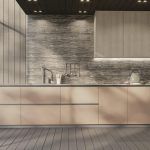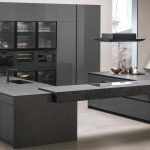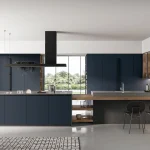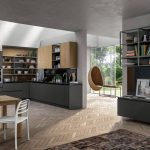
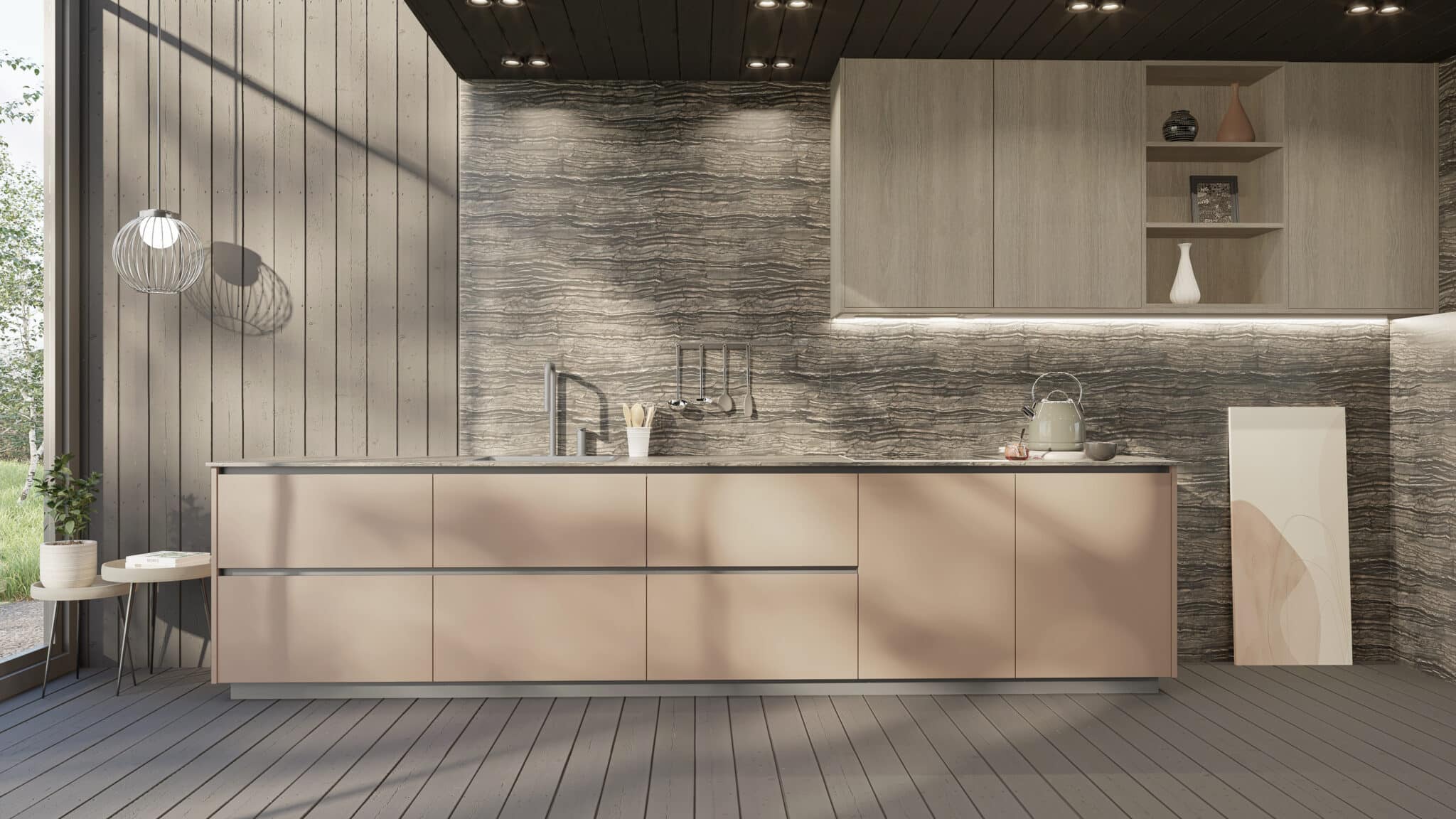
Here is the short version of European cabinets vs American cabinets: the difference starts at the front of the box. American cabinets are built with a face frame, a solid-wood border attached to the cabinet front that the doors hinge onto. European cabinets are frameless, so the doors hang directly from the box sides on concealed hinges. That one construction choice changes how much you can store, how the kitchen looks, how forgiving installation is, and where durability problems tend to show up. Frameless cabinets win on access and clean lines. Face-frame cabinets win on rigidity and on-site forgiveness. Neither style wins everywhere.
We should say up front where we stand. Prestige Cabinet designs and installs Italian-made European kitchen cabinets for homes across Orange County, so frameless construction is our daily work. That is exactly why we know its limits, and why our designers regularly tell homeowners when a framed approach would suit their house better.
Below, we break down the European cabinets vs American debate point by point: construction, storage, doors and hardware, materials, installation, and cost. We also cover the weak spots of frameless boxes that sales brochures rarely mention, and we finish with a checklist of questions to ask any cabinet company before you sign.
European Cabinets vs American: The Key Differences in 60 Seconds
Short on time? Here is how the two construction styles stack up on the decisions that shape a remodel.
- Box construction: American cabinets fasten a solid-wood face frame to the front of the box. European cabinets leave the frame off, so the sealed panel edges form the cabinet face.
- Usable storage: A frameless box opens to almost its full interior width. A face frame narrows every opening, and wide base units often add a center stile.
- Appearance: Frameless boxes suit full-overlay doors with slim, even gaps. Face frames suit visible frame lines, inset doors, and traditional trim.
- Hinges: Frameless cabinets use concealed cup hinges that adjust in several directions. Face-frame cabinets use exposed or concealed hinges mounted on the frame.
- Installation: Face frames can be scribed to uneven walls. Frameless runs need level floors, flat walls, and an installer who works to tight tolerances.
- Structure: The face frame stiffens the cabinet front. A frameless box has to get its strength from solid panels, sound joinery, and careful assembly.
Treat this list as a map, not a verdict. A difference that matters a great deal in one kitchen can be irrelevant in the next, which is why the European cabinets vs American question deserves the detail that follows.
Frameless vs Face-Frame Construction: What Is Actually Different
Almost every trade-off in this guide traces back to how the cabinet box is assembled. Understand the two methods, and the rest of the comparison falls into place.
Inside an American Face-Frame Cabinet
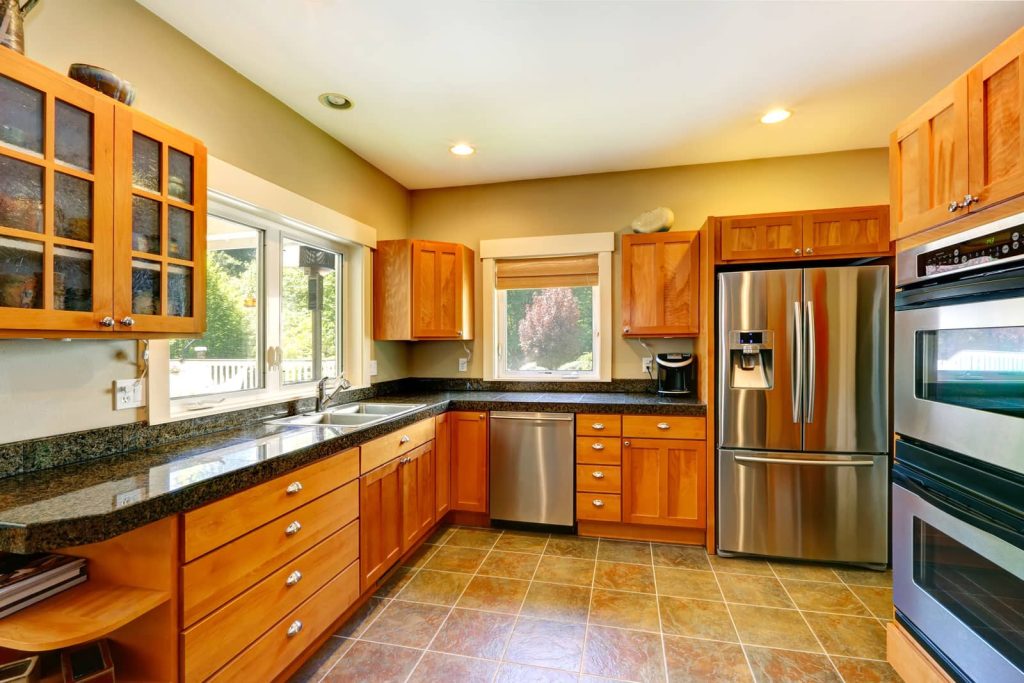
A face-frame cabinet begins as a simple box of plywood or particleboard: two sides, a top, a bottom, and a back. Rails and stiles of solid wood are then glued and fastened across the front edges to form the frame. Doors and drawer fronts mount to that frame and can cover most of it (full overlay), part of it (partial overlay), or sit flush within it (inset).
That frame is more than trim. It squares the box, stiffens its front, and gives installers solid wood to clamp and screw neighboring cabinets together. It is the reason face-frame construction became the American default: it tolerates small errors in the shop and on site. Our Inset Cabinets page goes further into framed construction and the flush doors that depend on it.
Inside a European Frameless Cabinet
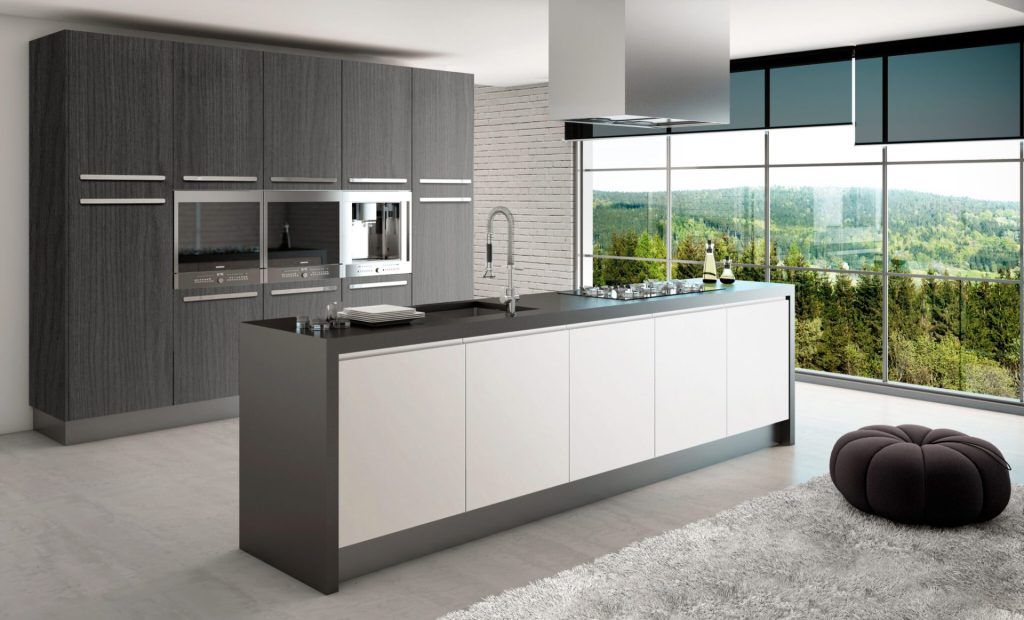
Frameless construction, also called full-access cabinetry, removes the frame altogether. The front edges of the box panels become the cabinet face and are sealed with edge banding. Doors fix directly to the inside of the box sides on concealed cup hinges, and drawers ride on full-extension slides mounted to the same panels.
With no frame to lean on, the box must be strong on its own. Good frameless cabinetry achieves that with solid panels, tight joinery, and accurate machining. Most European systems also rely on a standardized pattern of pre-drilled holes for hinges, shelves, and hardware, which keeps components aligned and easy to replace. For a closer look at frameless boxes paired with a classic door, see our European Shaker Kitchen Cabinets page.
“European” Is a Building Method, Not a Passport
One clarification saves a lot of confusion. “European” describes how a cabinet is built, not where it comes from. Many North American shops now make frameless lines, and some European kitchens wear framed-look doors. When you evaluate European cabinets vs American options, judge the construction method, the materials, and the manufacturer’s standards, not the marketing label. In our case, the cabinetry is both: frameless by design and manufactured in Italy.
Storage and Access: Which Cabinet Style Holds More?
Storage is the strongest argument for frameless construction. A face frame overlaps the inner edge of each opening, so what you can reach through is narrower than the box behind it. On wide base cabinets, a center stile frequently divides the opening, getting in the way of large pans and roll-out shelves.
The exact gain depends on cabinet widths and on how wide a given manufacturer makes its frames, so treat any single percentage with suspicion. What doesn’t vary is the everyday feel: frameless drawers span nearly the whole box, and nothing blocks the back corners.
Deep Drawers and Full-Extension Slides
Base cabinets are where you notice it most. European-style kitchens usually replace door-and-shelf bases with deep drawers, so you lift pots out from above rather than kneeling to search a dark cupboard. Full-extension slides bring the back of each drawer into the light, and the wider drawer boxes take sheet pans, stockpots, and small appliances that a center stile would block.
Face-frame cabinets hold drawers too. The drawer box just has to clear the frame opening, so it ends up a little narrower than the cabinet that houses it.
Corners, Pantries, and Tall Units
Blind-corner mechanisms, pull-out pantries, and appliance garages are available in both systems. Frameless boxes give that hardware more room to work, which usually means fewer compromises in awkward corners and tall units. Building to exact measurements helps even more: custom kitchen cabinets sized to each wall avoid the filler strips that stock widths leave behind. In the European cabinets vs American storage comparison, frameless leads on access, but a well-planned framed kitchen with good organizers can narrow the gap. Layout still matters more than the box.
Doors, Hinges, and Hardware: The Look and Feel of Each Style
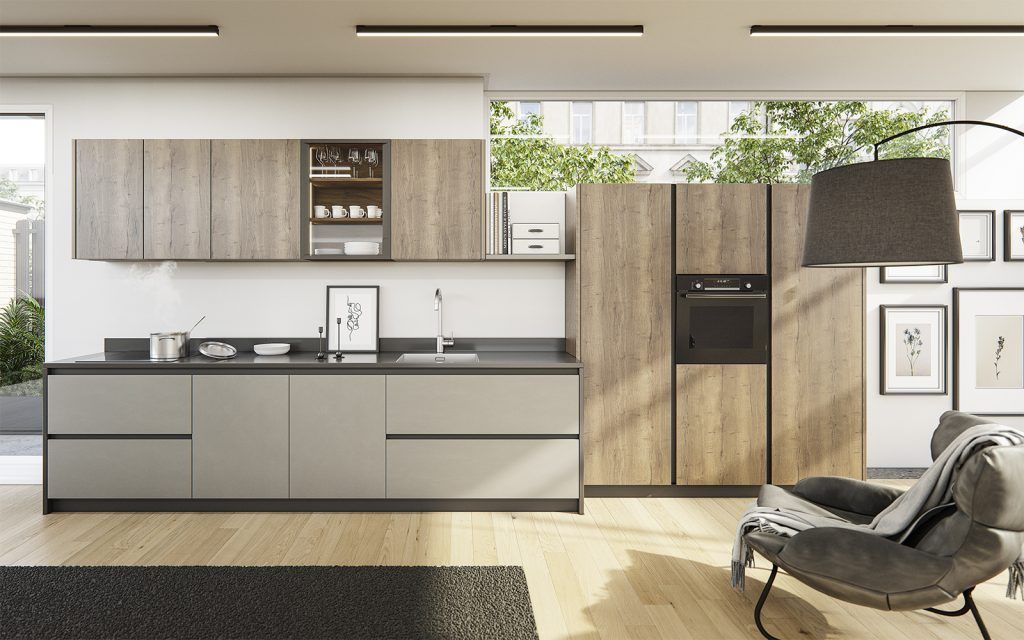
Construction determines what is possible; the doors determine what you live with. Frameless boxes nearly always take full-overlay doors that cover the whole cabinet front, with only a slim, consistent gap between them. That continuous surface is the look most people picture when they think of a modern European kitchen.
Full-Overlay, Inset, Slab, and Handleless Fronts
Face-frame cabinets can wear full-overlay doors as well, though the frame still shows in the gaps and at exposed ends. Inset doors, which sit flush within the cabinet face, demand the tightest tolerances of any construction. They have traditionally been built on a face frame, so ask any supplier how its inset system is made.
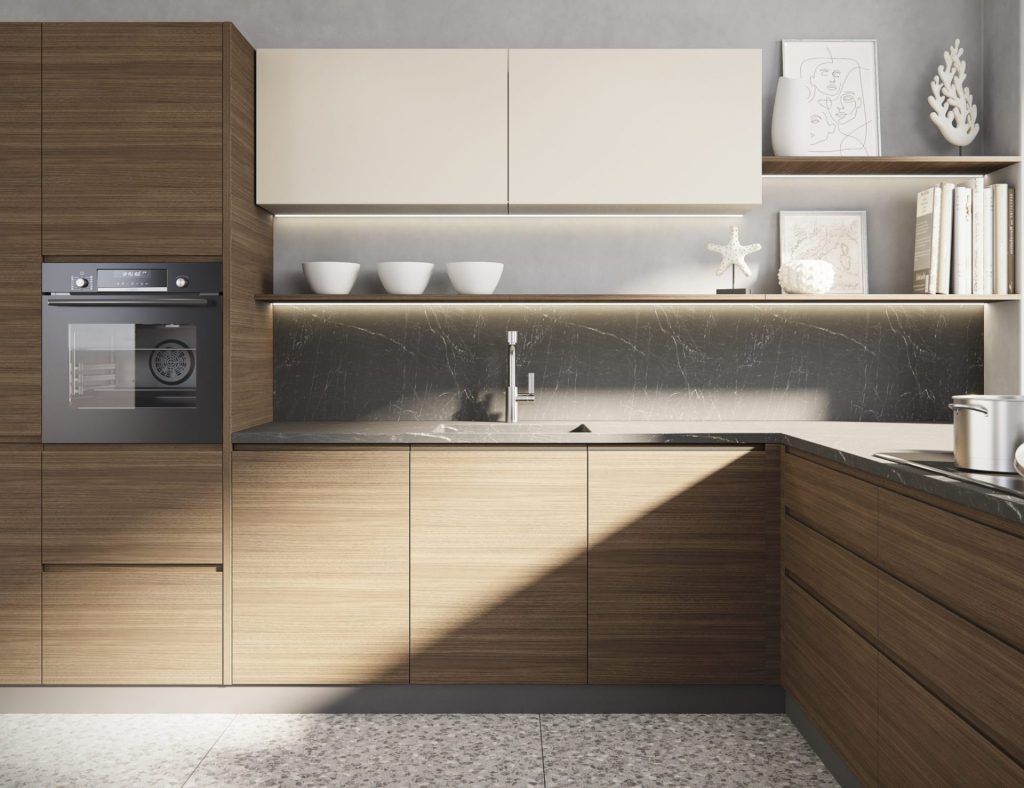
Frameless construction is also what makes the cleanest modern fronts practical. Flat slab cabinet doors read as one continuous plane across a run, and handleless kitchen cabinets replace pulls with finger channels, recessed rails, or push-to-open mechanisms. Both depend on the tight, even reveals that frameless boxes deliver.
Concealed Hinges and Soft-Close Mechanisms
Concealed cup hinges were created for frameless furniture and are still the standard there. A screwdriver adjusts them in several directions, so an installer can fine-tune every gap, and most quality hinges now include built-in soft-close. Many American manufacturers mount concealed hinges on their face frames too, so the hinge alone no longer separates the two styles.
The real difference is how visible small errors become. When every frameless door lines up edge to edge with its neighbor, a slight misalignment stands out, so the hardware has to be good and stay good. Whenever you compare European cabinets vs American hardware packages, ask who makes the hinges and drawer slides and what warranty stands behind them.
Materials and Durability: Solid Wood, Engineered Panels, and Finishes
Many shoppers assume American cabinets are “real wood” and European cabinets are “particleboard.” The reality is more interesting, and it affects how your kitchen will age.
Engineered Panels Are Not a Shortcut
Nearly every cabinet uses engineered panels somewhere: plywood, medium-density fiberboard (MDF), or particleboard. American face-frame cabinets usually combine those boxes with solid-wood frames and doors. European cabinets more often use engineered cores throughout, faced with laminate, lacquer, or real wood veneer.
Solid wood is beautiful, but it is never completely still. The USDA Forest Products Laboratory’s Wood Handbook explains that the moisture in wood moves toward equilibrium with the humidity of the surrounding air, and that keeping moisture content under control is how dimensional problems are avoided. That is why solid-wood doors and frames can shift slightly from season to season, and why a well-made engineered core stays flatter across a wide door.
The Weak Spots of Frameless Boxes, Honestly
This is the section most showrooms leave out. The Kitchen Cabinet Manufacturers Association (KCMA), which runs the ANSI/KCMA A161.1 certification program, puts certified cabinets through 14 tests covering structure, door and drawer operation, and finish durability. Those include a 600-pound load test on wall cabinets and 25,000 open-and-close cycles for doors and drawers under load.
KCMA also notes that frameless cabinets have no structural face frame, so the box itself must be especially robust, and that frameless boxes show a higher initial failure rate on its base front joint loading test. It flags seamed doors too, such as edge-banded slabs, which can swell and bubble when moisture gets past poorly machined seams.
None of that rules out European cabinetry. It shows you exactly where quality lives: panel construction, joinery, edge sealing, and hardware. A well-built frameless box is extremely durable, while a cheap one reveals its shortcuts sooner than a cheap framed box would. Of everything in the European cabinets vs American durability debate, that is the point worth remembering.
Formaldehyde Rules Apply to Both Styles
Whichever way you go, the composite panels inside are regulated. Under the EPA’s TSCA Title VI formaldehyde emission standards, hardwood plywood, MDF, and particleboard sold in the United States, and finished goods made with them, must be labeled as compliant. EPA wrote the national rule to stay consistent with California Air Resources Board requirements. Ask to see the compliance label or paperwork, whether your cabinets are built overseas or across town.
Installation, Tolerances, and Long-Term Adjustment
Installation is where face-frame cabinets score their clearest win. A frame can be trimmed, or scribed, to follow a wavy wall or an out-of-plumb corner, and minor errors disappear behind its edges. In older homes with settled floors and imperfect plaster, that forgiveness is worth a lot.
Frameless cabinetry offers no such cover. Because doors and drawers sit edge to edge with uniform gaps, every box must be level, plumb, and in plane with the next. Installers absorb irregularities with adjustable legs, filler panels, and scribe strips at the walls, but the margin for error is thin and the finish quality depends on skill. That is why the installer deserves as much scrutiny as the cabinets in any European cabinets vs American decision.
After installation, the advantage swings the other way. Concealed hinges and adjustable drawer fronts let you realign a frameless kitchen years later, often in minutes. A sagging face-frame door, or a solid-wood frame that has moved with the seasons, usually takes more work to put right. You can see how finished frameless kitchens look in our project gallery.
Cost and Value: What Actually Moves the Price
You will hear confident claims that one style is always cheaper. In practice, construction method is just one line in the equation. KCMA itself identifies material quality and market segment as the primary drivers of cabinet cost. These factors usually move a quote far more than frame versus frameless:
- Box material: plywood, MDF, and particleboard each span a wide range of grades.
- Door style and finish: high-gloss lacquer, matte and textured finishes, painted doors, and natural veneers each carry different material and labor costs.
- Hardware: premium hinges, slides, and lift systems cost more upfront and tend to last longer.
- Interior organizers: pull-outs, dividers, and corner mechanisms add up quickly.
- Sizing: made-to-measure boxes versus stock widths finished with filler strips.
- Installation: precise frameless work takes skill and time.
So when you line up European cabinets vs American quotes, compare like with like: equivalent box materials, equivalent hardware, and the same interior fittings. Judge value by usable storage and service life rather than by the total alone. A kitchen that costs a little more upfront but stores more and stays adjustable for years is often the better investment.
Which Cabinet Style Fits Your Kitchen Remodel?
Use these lists as a starting point, then test your instincts in person. A few minutes of opening drawers and swinging doors in a showroom will tell you more than any brochure.
Face-Frame Cabinets Make Sense If…
- Your home is traditional, and you want visible frame lines, beaded details, or classic framed doors
- Your walls and floors are noticeably out of square, and you want maximum installation forgiveness
- You love solid wood and accept that it will move slightly with the seasons
- You expect future repairs to be handled with ordinary local carpentry
- Period character matters more to you than capturing every inch of storage
Frameless Cabinets Make Sense If…
- You want the most usable storage from your existing footprint
- You prefer deep drawers to door-and-shelf base cabinets
- You like clean lines, flat doors, handleless fronts, and tight, uniform gaps
- You value easy adjustment of doors and drawer fronts for years to come
- You have an installer who is experienced with frameless systems
The Middle Ground: Transitional Kitchens
The European cabinets vs American choice is rarely all or nothing. Transitional kitchens pair frameless boxes with five-piece Shaker or thin-frame doors, painted finishes, and classic hardware, so you keep frameless access behind a traditional face. Two-tone kitchen cabinets take the idea further, for example warm wood lowers beneath painted uppers. Browse our classic kitchen collection and modern kitchen collection side by side to see where your taste lands.
Questions to Ask Before You Sign a Cabinet Contract
Whichever way you lean, these questions separate well-built cabinetry from look-alikes. A reputable cabinet company will answer each one without hesitation.
- What are the cabinet boxes made of, and how is panel quality specified?
- How are panel edges sealed, particularly around the sink and dishwasher?
- Who makes the hinges and drawer slides, and what warranty covers them?
- Has this cabinet line been tested to a recognized performance standard, such as ANSI/KCMA A161.1?
- Can you show the TSCA Title VI compliance label or documentation?
- Who installs the cabinets, and how much frameless experience does the crew have?
- Will I approve a detailed drawing or 3D rendering before production starts?
- Which interior organizers are in the quote, and which cost extra?
Asking every bidder the same questions turns the European cabinets vs American comparison from a sales pitch into an apples-to-apples decision.
FAQs: European Cabinets vs American Cabinets
Neither style is better across the board. European frameless cabinets offer more accessible storage, a cleaner contemporary look, and easy adjustment over time. American face-frame cabinets offer extra front rigidity, more forgiveness during installation in older homes, and authentic traditional detail. The right choice is the one that suits your home’s architecture, your storage needs, and the quality of the manufacturer and installer you hire.
Yes, in terms of usable access, although the exact gain depends on cabinet widths and the manufacturer. With no face frame narrowing each opening and no center stile splitting wide bases, frameless drawers and pull-outs run almost the full interior width. You will notice it most in base drawers and corner units. A smart layout and good organizers matter just as much.
They can be, because durability depends more on build quality than on construction style. With no stiffening frame, frameless boxes rely on solid panels, strong joinery, and well-sealed edges. KCMA reports that frameless boxes fail its base front joint loading test more often on a first attempt, so ask about panel construction, edge banding, and any third-party performance testing before you buy.
Not inherently. Construction style is only one cost factor. Box material, door finish, hardware, interior organizers, sizing, and installation complexity usually affect the final price more. The only reliable way to see the real difference for your kitchen is to compare quotes with matching materials and hardware.
Yes. Frameless boxes can carry Shaker, raised-panel, or thin-frame doors, painted finishes, glass-front uppers, and classic hardware. This transitional approach pairs modern storage with traditional character. If you want true inset doors, ask how the supplier builds them, since inset has traditionally relied on a face frame.
Final Verdict: Choosing With Confidence
There is no universal winner in the European cabinets vs American debate, only a better fit for your home. Frameless construction is hard to beat if you want maximum access, clean lines, and easy adjustment for years to come. Face-frame cabinetry still makes sense if you value installation forgiveness and classic framed detail. Either way, the quality of the box, the hardware, and the installation matters more than the label on the brochure.
At Prestige Cabinet, our Italian-made cabinetry is designed in California, fitted with European-engineered hardware backed by a lifetime warranty, and offered in both modern and classic styles. Visit our Santa Ana or Laguna Niguel showroom to open the drawers, compare finishes, and test the hardware for yourself. Or book a free design consultation, and one of our designers will show you how each construction style would work in your kitchen before you commit to anything.