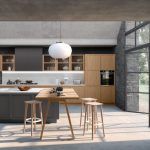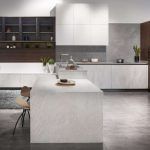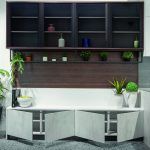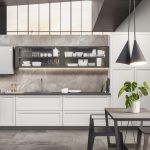

European Shaker and traditional Shaker cabinets share the same door: a five-piece frame with a flat, recessed center panel and square inside edges. What changes is everything around that door. Traditional shaker cabinets sit on a face-frame box, usually with partial-overlay or inset doors, wider rails and stiles, and furniture-like painted finishes. European Shaker puts a slimmer version of the same door on a frameless box with full-overlay doors, tight reveal lines, concealed adjustable hinges, and more usable interior space. One reads as heritage; the other reads as architecture.
That is the short answer. The longer answer matters, because the difference between these two versions of the same style touches how your kitchen looks from the doorway, how much fits inside each cabinet, and how the room will feel in fifteen years. At Prestige Cabinet, the request we hear most often in our Orange County showrooms is for a kitchen that feels warm and familiar but still lives like a modern one. Most clients do not have a name for that combination. Very often, the name is European Shaker.
This guide walks through where the Shaker style came from, what both versions of shaker cabinets keep in common, the specific details that separate them, and how to decide which one belongs in your home.
The Short Version: European vs. Traditional Shaker at a Glance
If you only have a minute, here is how the two styles compare:
- The door itself: Both styles of shaker cabinets use the classic recessed-panel door. European versions usually have narrower rails and stiles and a crisper edge.
- The cabinet box: Traditional shaker cabinets are typically built with a face frame on the front of the box. European Shaker is built frameless, with the door covering the box edge.
- The reveal: Traditional styles show the face frame around each door. European Shaker shows only a thin, even gap between doors.
- The hinges: Traditional versions may use exposed or semi-concealed hinges. European Shaker uses concealed, multi-way adjustable hinges.
- The storage: Frameless boxes remove the frame lip, which opens up wider drawers and easier access to the full interior.
- The mood: Traditional reads as farmhouse, colonial, or cottage. European reads as transitional, clean, and contemporary.
Neither is “better.” They are two dialects of the same design language, and the right choice depends on your architecture, how you cook, and how you want the room to feel.
Where the Shaker Style Came From (and Why It Still Works)
To understand what European designers changed, it helps to know what they started with.
The Shaker Principles: Honesty, Utility, and Simplicity
The Shakers were a religious community that came to America from England in 1774. According to The Metropolitan Museum of Art’s essay on Shaker furniture, their guiding principles of honesty, utility, and simplicity shaped everything they built. Shaker makers rejected excessive ornament, which they associated with pride, and focused instead on overall form and proportion. They avoided veneers, inlays, and carving, worked in local woods such as pine, maple, and cherry, and replaced imported brass pulls with simple turned-wood knobs.
Two other details from the Met’s account matter for anyone choosing shaker cabinets today. First, most original Shaker pieces were painted or stained, both to protect the wood and to make it more attractive. The all-white Shaker kitchen is a modern habit, not a historical rule. Second, Shaker case furniture was often built into the room itself or designed to fit a specific space. In other words, the Shakers were already thinking like fitted-kitchen designers more than a century before the fitted kitchen existed.
How a Furniture Idea Became the Default Kitchen Door
The Shaker door survived because it solves real problems. A recessed panel inside a sturdy frame lets solid wood expand and contract with humidity without cracking. Flat surfaces with square inside corners are easy to paint and easy to clean. And because the door has no carving or applied moulding, it sits comfortably in almost any room.
That neutrality is why shaker cabinets have become one of the most widely installed door styles in American kitchens. The same quality is what made the door so easy for European manufacturers to adapt. A design built on proportion rather than decoration can be refined without losing its identity.
What Stays the Same: The Core DNA of Shaker Cabinets
Before getting into differences, it is worth being precise about what does not change. If a door loses any of these traits, it is no longer really Shaker.
The Five-Piece Recessed-Panel Door
Every Shaker door, European or traditional, is built from five parts: two vertical stiles, two horizontal rails, and one flat center panel set slightly back from the frame. That recess creates the shadow line that gives the door its quiet depth. Drawer fronts usually follow the same pattern, though very shallow drawers are often made as a slab or a single-rail front to keep proportions right.
Square Inside Edges and No Applied Ornament
The inside edge where the frame meets the panel is square or very nearly square. There is no ogee, no bead, no raised field. This is the detail that separates Shaker from its more decorative cousin, the raised-panel door, which uses a shaped center panel that sits proud of the frame. If you are drawn to more shadow and more traditional detail, our page on raised panel kitchen cabinets explains when that profile is the better fit.
Restraint as a Design Principle
Both versions of shaker cabinets follow the same rule the original makers did: let proportion, material, and finish do the work. European designers simply apply that rule to a different set of materials and a different idea of what a kitchen should feel like.
What Actually Changes Between European and Traditional Shaker Cabinets
Here is where the two styles of shaker cabinets part ways. Some of the changes are visible from across the room. Others only show up when you open a drawer.
Cabinet Box Construction: Face Frame vs. Frameless
The biggest structural difference is not in the door at all. It is in the box behind it.
Traditional shaker cabinets are usually built with a face frame, a solid-wood frame attached to the front edge of the cabinet box. Doors hang on that frame, and the frame stays visible around each door. European Shaker uses frameless construction, where the door mounts directly to the side of the box and covers its front edge almost completely.
We covered this distinction in depth in our guide to framed vs frameless cabinets, so here is the part that matters for this decision: the box changes the look of the door. A face frame adds a second visible layer around every opening, which reads as furniture. A frameless box removes that layer, so the doors read as one continuous surface.
Door Overlay and Reveal Lines
Overlay describes how much of the cabinet box the door covers. Traditional Shaker kitchens typically use partial overlay, where you see a strip of face frame between doors, or inset, where the door sits flush inside the frame. Inset is the most demanding and most traditional of the two, and our page on inset cabinets explains why it carries a premium.
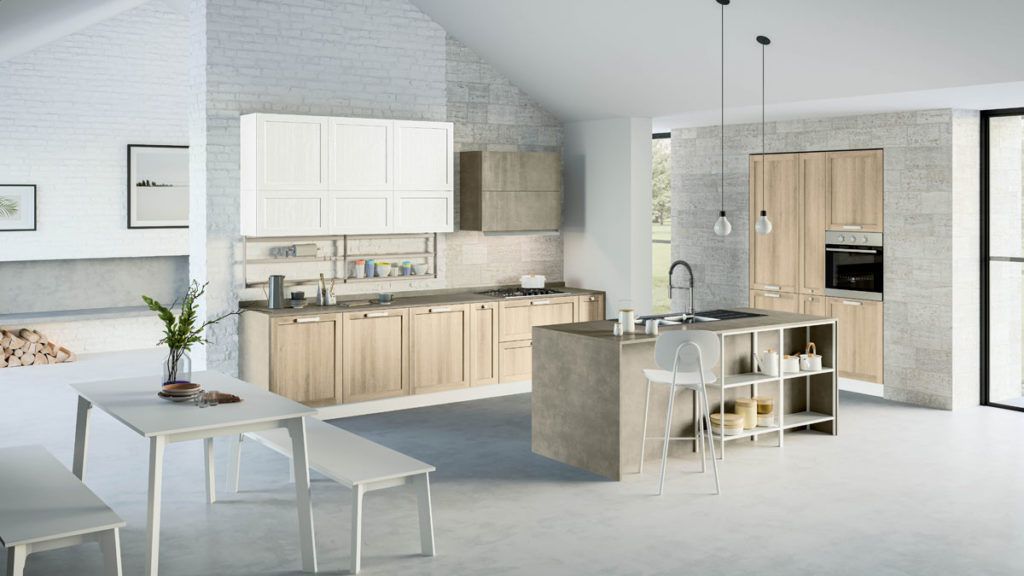
European Shaker uses full overlay. The doors cover nearly the whole box, leaving only a narrow, even gap between neighboring doors and drawers. That consistent reveal line is one of the strongest visual cues that you are looking at European shaker cabinets rather than traditional ones. Run your eye along a European Shaker wall and the gaps line up like a grid. On a traditional run, the face frame creates a rhythm of wider and narrower bands.
Rail and Stile Proportions: Classic Width vs. Slim Profile
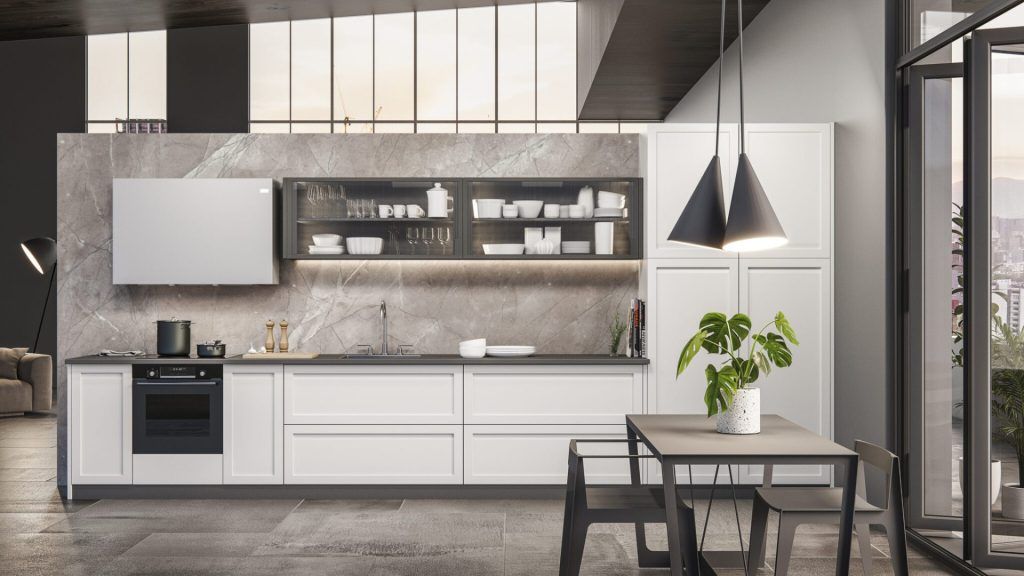
This is the change most homeowners notice first, even if they cannot name it. Traditional shaker cabinets use relatively wide rails and stiles, which gives the door a sturdy, hand-built character. European Shaker doors often use noticeably narrower frames, sometimes called slim Shaker or skinny Shaker. The center panel gets larger, the frame becomes a fine outline, and the whole door looks lighter.
Slim profiles have become a defining feature of the current European look. They let the door keep its Shaker identity while sitting comfortably next to slab doors, open shelving, or a sleek range hood. If you love the clean geometry of flat doors but want a little more depth, a slim Shaker profile is often the bridge. For a direct look at the fully flat alternative, see our flat-panel slab cabinets page.
Finish and Color Palette
Traditional shaker cabinets lean toward painted finishes in white, cream, sage, navy, or a soft gray, often with a slightly brushed or hand-finished character. Some traditional kitchens use glazing or distressing to suggest age.
European Shaker finishes tend to be more uniform and more varied in material. You will see smooth matte lacquers, factory-applied paints with a very even sheen, and real wood veneers in white oak, walnut, or ash with the grain running cleanly across the panel. Warm, stained wood is increasingly common, which brings European Shaker surprisingly close to the original Shaker habit of finishing wood in color rather than leaving it raw. For more on that direction, our page on wooden cabinets is a good next read.
Hardware, Hinges, and Drawer Systems
Hardware is where European engineering shows most clearly. Traditional shaker cabinets often pair the door with visible hardware choices that are part of the style: wooden knobs, cup pulls, latches, and sometimes exposed butt hinges on inset doors.
European shaker cabinets rely on concealed hinges that mount inside the box and adjust in several directions, so doors can be fine-tuned after installation. Drawer systems usually run on full-extension, soft-close runners. Pulls on European Shaker tend to be simpler and more linear, such as slim bar pulls or edge pulls, and some designs go handleless on upper cabinets. The original Shakers chose turned-wood knobs because they were honest and functional. European Shaker makes the same choice for the same reason, with modern materials.
Edge Details and Panel Depth
Small machining choices separate the two looks as well. Traditional doors often have slightly softened outer edges and a deeper panel recess, which catches more shadow. European Shaker doors usually have a crisper outer edge and a shallower, more precise recess. The effect is subtle up close and very noticeable across a full kitchen, where the European version reads as sharper and more graphic.
How the Differences Show Up in Daily Kitchen Use
Style is only half the decision. The other half is how the cabinets behave when you are cooking dinner for six on a Tuesday.
Storage Access and Usable Interior Space
Because frameless boxes have no face-frame lip at the opening, drawers can run nearly the full interior width of the cabinet, and large items slide in without catching on a frame edge. This is the most practical advantage of European shaker cabinets and the reason it appeals to people who cook a lot or store bulky cookware, small appliances, or large serving pieces.
Traditional face-frame shaker cabinets give up a little of that interior width, but the frame adds rigidity at the front of the box and gives installers more room to scribe cabinets to uneven walls, which helps in older homes.
Cleaning and Maintenance
All shaker cabinets share one cleaning challenge: the inside corner where the panel meets the frame can collect dust and grease. Shallower, crisper recesses on European doors tend to be a little easier to wipe. Smooth factory finishes also clean more predictably than brushed or glazed traditional finishes.
On the other hand, a painted traditional finish is often easier to touch up. A small chip on a classic painted Shaker door can sometimes be repaired in place, while a high-precision lacquer may need professional refinishing to match perfectly.
Durability, Wood Movement, and Long-Term Adjustment
The Shaker door’s floating panel was designed to handle seasonal wood movement, and that advantage applies to both styles. Coastal Southern California’s relatively mild humidity swings are kind to wood cabinetry in general.
Where the two diverge is long-term adjustment. Concealed European hinges can be tweaked with a screwdriver to correct a sagging or misaligned door. Traditional inset doors, by contrast, depend on precise initial installation to keep their tight, even gaps, which is part of why they are more demanding to build and install.
Which Shaker Kitchen Cabinet Style Suits Your Home?
Orange County has an unusually wide range of architecture, from Spanish Revival and coastal cottages to new transitional builds and modern hillside homes. That variety is exactly why this decision deserves more than a photo on a mood board.
When Traditional Shaker Cabinetry Is the Right Call
Traditional shaker cabinets are usually the stronger choice when:
- Your home has period architecture, such as Craftsman, colonial, farmhouse, or Cape Cod influences.
- You want the kitchen to feel like furniture, with visible frames, painted finishes, and classic hardware.
- You are drawn to inset doors and are comfortable with the extra craftsmanship they require.
- The rest of the house uses substantial trim, beadboard, or traditional millwork that a slimmer door would look underdressed against.
When European Shaker Is the Stronger Choice
European shaker cabinets tend to win when:
- Your home is a transitional or contemporary build with open-plan living.
- You value maximum drawer width and easy access to deep storage.
- You want a clean, continuous look with consistent reveal lines.
- You like the warmth of a recessed-panel door but find traditional proportions a little heavy.
- You plan to mix door styles, for example slim Shaker on the perimeter with a flat-panel island.
Many of our clients land here without realizing it. They want recognisable warmth without period heaviness, which is exactly what European Shaker was designed to deliver. You can see how we approach the style on our European Shaker kitchen cabinets page.
Transitional Kitchens and Two-Tone Layouts
You do not have to choose one camp completely. Some of the most successful kitchens combine slim Shaker uppers with wood-veneer lowers, or pair a painted perimeter with a stained island. Two-tone schemes work especially well with shaker cabinets because the recessed panel gives each color a little depth. Our guide to two-tone kitchen cabinets covers how to balance tones and materials.
How to Judge Quality in Any Shaker Cabinet Door Style
Whichever version you choose, the style on the door tells you nothing about what is inside the box. These checks apply to both.
Look for Third-Party Performance Certification
The Kitchen Cabinet Manufacturers Association administers the ANSI/KCMA A161.1 standard, which KCMA describes as the only performance standard for kitchen and bath cabinets. According to KCMA’s guide to certified cabinet durability, certified cabinets must pass a battery of 14 tests covering structure, door operation, drawer cycles, and finish, including a 600-pound load test on wall cabinets and 25,000 open-and-close cycles on doors and drawers under load.
KCMA also notes that frameless, European-style cabinets are eligible for the seal, and that because frameless boxes have no structural face frame, the box itself must be especially robust. That is a useful question to ask any supplier of European Shaker: how is the box engineered to carry load without a frame?
Ask About Formaldehyde Compliance for Composite Materials
Many cabinet boxes and some door cores use engineered panels. The U.S. Environmental Protection Agency’s formaldehyde emission standards for composite wood products apply to hardwood plywood, medium-density fiberboard, and particleboard, as well as finished goods that contain them. Since March 2019, regulated products sold in the United States must be labeled as TSCA Title VI compliant, and EPA developed the rule to be consistent with California Air Resources Board requirements. Ask to see compliance documentation for the shaker cabinets you are considering, whether they are built in the United States or imported.
Inspect the Door, Not Just the Photo
Photographs flatten Shaker doors. In person, check:
- Joint tightness: The corners where rails meet stiles should be tight and even.
- Panel recess: The recess depth and edge should be consistent from door to door.
- Finish coverage: Paint or lacquer should cover the inside corners cleanly without pooling.
- Reveal consistency: On European Shaker, the gaps between doors should be even across the run.
- Drawer action: Open a fully loaded drawer and let it close on its own.
These details are why we encourage clients to see doors side by side before committing.
Making the Decision: A Simple Framework
If you are still weighing the two, work through these questions in order:
- What does the architecture of your home ask for? Period homes generally favor traditional proportions. Transitional and modern homes lean European.
- How do you use your storage? If drawer width and deep-cabinet access matter a lot, frameless European construction has a real practical edge.
- Do you want the kitchen to read as furniture or as architecture? Face frames and inset doors feel like furniture. Full overlay and tight reveals feel built-in.
- Which finish suits how you live? Painted traditional finishes are easy to touch up. Smooth European finishes clean predictably.
- Will you mix door styles? If an island or a feature wall will use flat or wood-veneer doors, a slim Shaker profile blends more naturally.
Whatever your answers, the best way to settle the question is to put your hands on both. At Prestige Cabinet, you can compare door profiles, finishes, and drawer systems side by side at either of our Orange County showrooms:
- Santa Ana: 650 S Grand Ave, Santa Ana, CA 92705
- Laguna Niguel: 23811 Aliso Creek Rd, Unit 160, Laguna Niguel, CA 92677
Our designers can model both versions of shaker cabinets in your actual floor plan, so you can see the difference before you decide. Book a design consultation to get started, or browse our full range of classic kitchen cabinets.
Frequently Asked Questions About Shaker Cabinets
What is the main difference between European Shaker and traditional Shaker cabinets?
The door style is the same: a five-piece frame with a recessed center panel. The main difference is construction and proportion. Traditional shaker cabinets typically use a face-frame box with partial-overlay or inset doors and wider rails. European Shaker uses a frameless box, full-overlay doors, slimmer rails, and concealed adjustable hinges, which creates a cleaner look and more usable interior space.
Are European Shaker cabinets more modern than traditional Shaker cabinets?
Yes, in look and in engineering. European Shaker keeps the familiar recessed panel but pairs it with slim proportions, tight reveal lines, and frameless boxes, so it reads as transitional or contemporary. Traditional Shaker reads as farmhouse, colonial, or cottage. Both are timeless in the sense that the door shape itself has stayed popular for generations.
Do frameless shaker cabinets give you more storage?
Generally, yes. Without a face-frame lip at the front of the box, drawers can run closer to the full interior width, and large items are easier to slide in and out. The gain matters most in drawer-heavy kitchens and in base cabinets used for pots, pans, and small appliances.
Can I mix European Shaker cabinets with other door styles?
Yes, and this is one of the style’s strengths. Slim European Shaker profiles pair naturally with flat-panel slab doors, wood-veneer islands, glass-front uppers, and open shelving. The key is keeping reveal lines and finish undertones consistent so the mix looks intentional.
Are shaker cabinets going out of style?
No. Shaker has stayed in demand because its design is built on proportion rather than decoration, which lets it adapt to new materials and color trends. The current shift is toward slimmer frames, warmer wood tones, and matte finishes, all of which keep the style feeling current rather than dated.