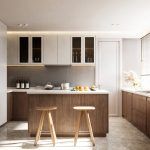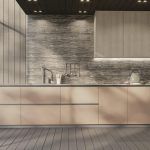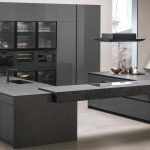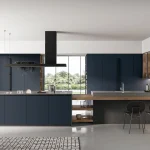
Walk into a kitchen designed in 2026 and the first thing you notice isn’t the countertop or the range. It’s the cabinetry. Modern kitchen cabinets have quietly become the single most influential design decision in a remodel – they set the color story, define the storage, and account for the largest share of most kitchen budgets.
But “modern” means something different this year than it did five years ago. The cold, all-white, high-gloss kitchen has given way to something warmer, quieter, and considerably more tactile. Homeowners are asking for modern kitchen cabinets that feel like furniture rather than appliances.
At Prestige Cabinet, we design custom Italian-made cabinetry for homeowners across Orange County, and we’ve watched this shift happen project by project. This guide distills what we’ve learned into a practical roadmap: the styles that are actually being installed, the materials worth paying for, the construction details that separate luxury from builder-grade, and the honest cost picture for 2026.
What Defines Modern Kitchen Cabinets in 2026?
Modern kitchen cabinets in 2026 are defined less by a single look and more by a set of principles: clean lines, concealed function, natural materials, and finishes that reward touch as much as sight.
The National Kitchen & Bath Association’s 2026 Kitchen Trends Report, drawn from feedback provided by 634 industry professionals across North America, spotlights the styles, colors, products, materials, and finishes expected to shape the next three years. Its findings line up almost exactly with what we see walking through our own showroom.
Warm Minimalism Has Replaced Cold Contemporary
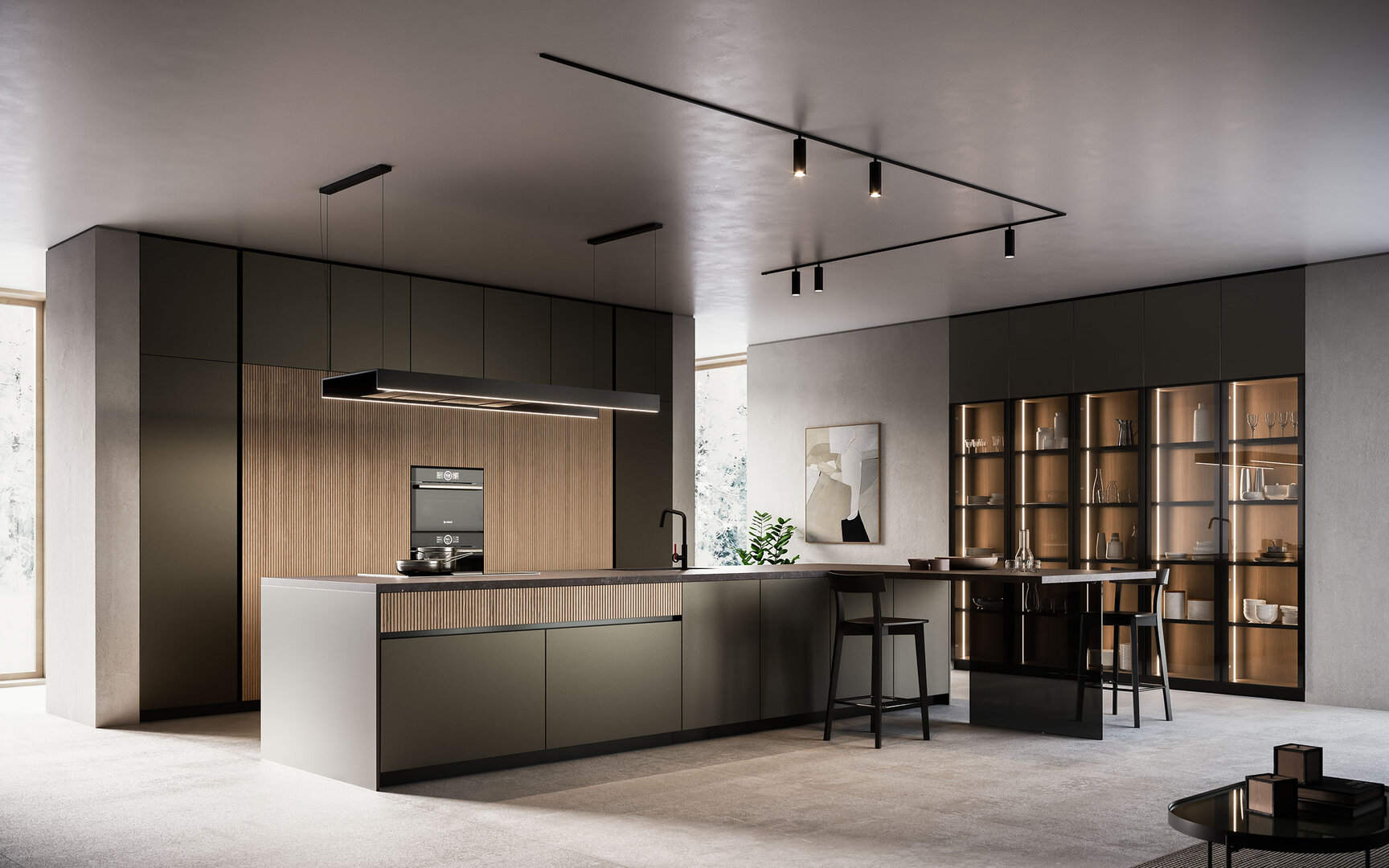
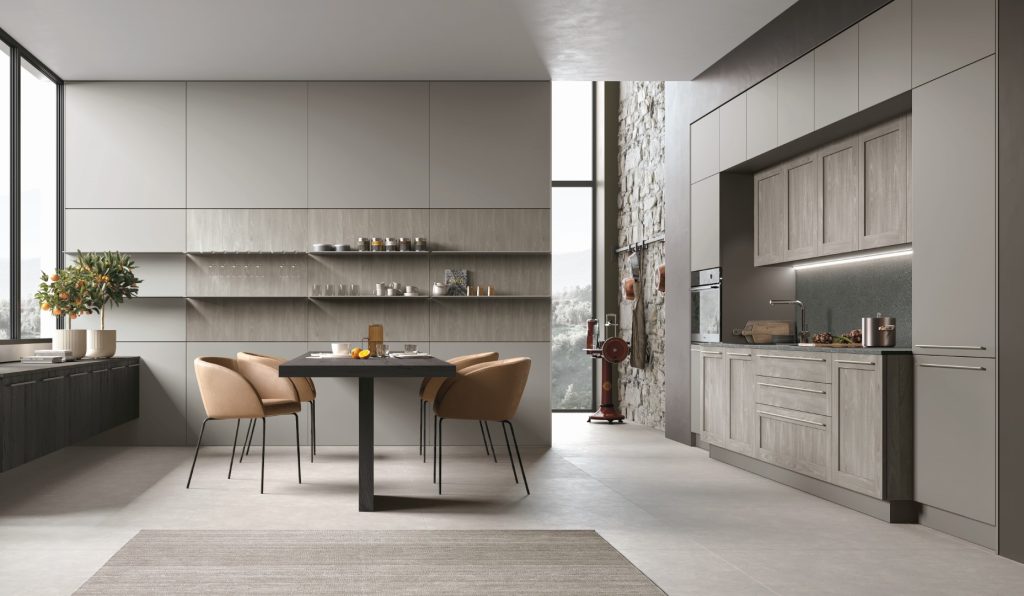
The defining characteristic of modern kitchen cabinets right now is warmth. Stark white lacquer boxes have been replaced by oak veneers, soft greiges, mushroom taupes, and putty tones. The lines are still clean – but the palette is human.
A whopping 96% of survey respondents identify neutrals as the most popular colors, with greens (86%) and blues (78%) close behind, while loud statement colors sit at the very bottom of the list.
Concealed Function Over Visible Hardware
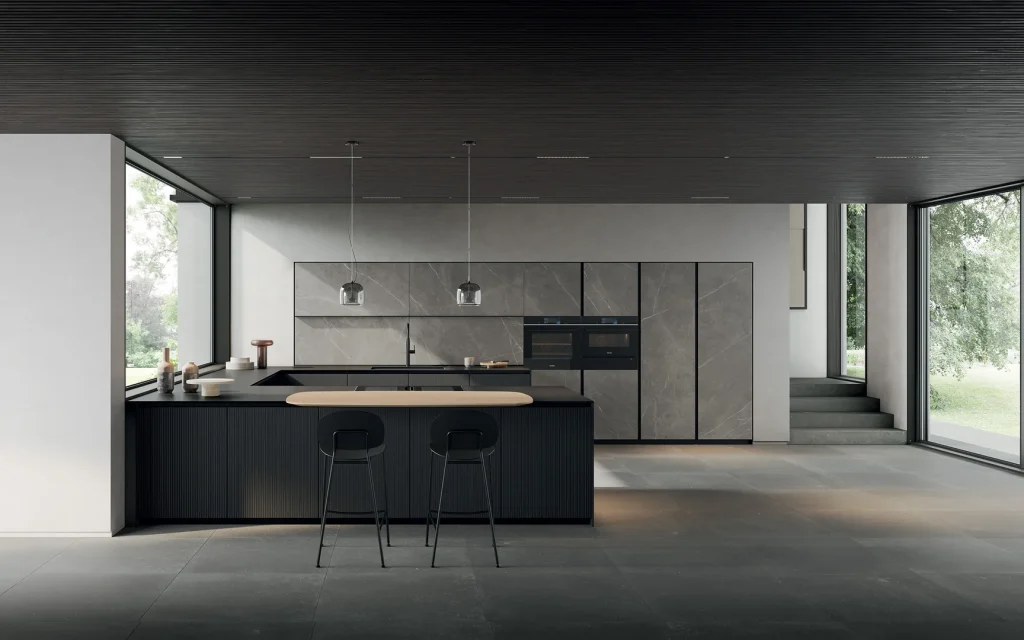
Handleless fronts, integrated finger pulls, push-to-open mechanisms, and panel-ready appliances all serve the same goal: an uninterrupted plane. When you strip visible hardware out of a kitchen, the cabinetry reads as architecture.
Kitchens Are Getting Bigger – And So Is the Cabinetry
Some 75% of respondents said kitchens are getting larger, even if homes are not, with that extra area often taken from adjacent, underused parts of the house – like formal dining rooms. More square footage means more linear feet of cabinetry, and more pressure on that cabinetry to perform.
The Core Traits at a Glance
Modern kitchen cabinets in 2026 typically share:
- Frameless (European) construction for maximum interior volume
- Flat-panel or lightly detailed slab doors rather than ornate raised panels
- Matte and satin finishes instead of high gloss
- Full-height storage running to the ceiling
- Integrated lighting inside and beneath the boxes
- Low-emission, certified materials for indoor air quality
Modern Kitchen Cabinet Styles Worth Considering
There’s no single “modern” door. Here are the contemporary cabinetry styles homeowners are actually specifying.
Slab and Flat-Panel Doors
The purest expression of modern kitchen cabinets. A single flat plane, no framing, no profile. Slab-front modern kitchen cabinets work in every material – lacquer, wood veneer, laminate, glass – and they age well because there’s no decorative detail to date.
Best for: minimalist kitchens, handleless designs, small spaces where visual noise is the enemy.
Fluted, Reeded, and Grooved Fronts
The biggest texture story of 2026. Vertical grooving adds shadow and rhythm without adding ornament. Grooved panels, slender fluting, chamfered edges, and hand-finished profiles suggest craftsmanship and quality without overwhelming a space. Used sparingly on modern kitchen cabinets – on an island, a tall pantry run, or a hood surround – fluting gives modern kitchen cabinets a custom, made-for-you feel.
Transitional Slim-Shaker
A narrow-rail Shaker door bridges classic and contemporary. Transitional and timeless design leads at 72%, followed by contemporary minimalism at 60% and organic natural styles at 58%. If your home is Mediterranean, Cape Cod, or traditional Spanish – common across Orange County – slim-shaker modern kitchen cabinets are often the smarter long-term choice.
Wood-Grain and Veneer Fronts
Wood cabinets are in strong demand, with 59% of surveyed designers, remodelers, showroom professionals, and contractors identifying them as a popular trend. Rift-cut white oak dominates the modern kitchen cabinets we build, followed by walnut for accent runs.
Glass, Metal, and Open Elements
Fluted or reeded glass uppers, bronze-framed vitrines, and a single run of open shelving are how designers break up long walls of modern kitchen cabinets without losing storage.
Cabinet Materials and Finishes That Define 2026
Material choice determines how your modern kitchen cabinets look on day one and how they look in year ten. This is where budgets should concentrate.
Matte Lacquer
Multi-coat lacquer over MDF delivers a perfectly flat, seamless surface – the signature look of Italian modern kitchen cabinets. Matte finishes are replacing glossy cabinets, with 60% of designers saying minimalism will gain momentum in 2026 while glossy lacquers decline.
- Pros: flawless color, any shade imaginable, extremely refined
- Consider: quality varies enormously by number of coats and curing process
Natural Wood Veneer
Real wood applied over a stable engineered core. Veneer gives you authentic grain without the seasonal movement of solid slab doors. Continuous-grain veneer – where the pattern flows across an entire run of modern kitchen cabinets – is a hallmark of high-end European fabrication.
Textured Laminates and Technical Surfaces
Laminate modern kitchen cabinets have almost nothing in common with the plastic-looking products of decades past. Anti-fingerprint technical surfaces resist heat, scratching, and marking, and they’ve become a favorite for hardworking family kitchens.
Metal and Mixed Materials
Brushed stainless, blackened steel, and aluminum-framed glass doors appear as accents rather than full runs – a way to add material contrast to modern kitchen cabinets without industrial coldness.
Color Trends for Modern Kitchen Cabinets
Color is where personality enters a kitchen, and it’s the decision homeowners agonize over most when specifying modern kitchen cabinets. The 2026 palette for modern kitchen cabinets falls into four reliable directions.
Warm Neutrals and Earth Tones
Greige, bone, oat, clay, and mushroom. Warm neutral modern kitchen cabinets are the safest long-term choice and the most requested finish family in our showroom.
Deep, Moody Saturates
Forest green, olive, charcoal, and inky navy. Dark modern kitchen cabinets photograph beautifully in marketing shots and feel enveloping in person – particularly effective in kitchens with strong natural light, which most Southern California homes have in abundance.
Two-Tone Combinations
Two-tone kitchens remain popular, with roughly one in five homeowners choosing contrasting upper and lower cabinet finishes – though the contrasts are becoming more subtle. The current formula: wood-grain uppers over painted lowers, or a contrasting island anchoring neutral perimeter cabinetry.
Wood as a Color
Rift white oak in a clear matte finish now functions as a neutral in its own right, and it’s the single most requested material for modern kitchen cabinets we design.
Cabinet Construction: What Separates Luxury From Builder-Grade
This is the section most guides skip, and it’s the one that determines whether your modern kitchen cabinets still close silently in fifteen years.
Frameless (European) vs. Face-Frame Construction
Frameless modern kitchen cabinets have no face frame across the front of the box, so the doors mount directly to the case.
- More usable interior volume – often 10–15% more per cabinet
- Full-access drawers and unobstructed corners
- Cleaner reveals and tighter, more consistent gaps
- The construction standard behind virtually all Italian modern kitchen cabinets
Face-frame construction remains appropriate for traditional inset designs, but for contemporary work, frameless is the benchmark.
Box Materials and Edge Banding
Look past the door of any modern kitchen cabinets you’re quoted. High-grade furniture-board or plywood cases with laser-applied edge banding will outperform stapled cases with glued PVC tape every time. Seamless laser edging eliminates the visible glue line that eventually yellows and lifts.
Hardware: The Invisible Difference
Hinges and drawer runners are the moving parts of your kitchen, and they’re used tens of thousands of times. European-engineered hardware – soft-close hinges with integrated dampening, full-extension undermount runners, and adjustable in three planes – is what allows luxury modern kitchen cabinets to feel effortless years after installation.
Ask any cabinet supplier three questions:
- Who manufactures your hinges and runners?
- What is the tested cycle rating on your drawer systems?
- What exactly does the warranty cover, and for how long?
At Prestige Cabinet, our cabinetry is backed by a lifetime warranty – a commitment we can only make because of how the boxes and hardware are engineered.
Storage and Organization Built Into Modern Kitchen Cabinets
Function is the reason well-designed modern kitchen cabinets look calm. Everything has somewhere to go.
Smarter storage is in demand, with floor-to-ceiling cabinetry featuring more drawers, walk-in and butler pantries, refrigerators with custom configurations (70%), and islands packed with storage topping the lists.
The storage features worth specifying in modern kitchen cabinets:
- Deep drawers instead of base doors – one motion to reach anything, no crawling
- Internal drawer-in-drawer systems for utensils and small tools
- Full-height pantry units with pull-out larder mechanisms
- Appliance garages behind pocket or tambour doors
- Toe-kick drawers reclaiming otherwise dead space
- Integrated waste and recycling pull-outs
- Dedicated coffee and beverage zones – one of the fastest-growing requests
Lighting Is Now Part of the Cabinetry
Under-cabinet lights (82%), interior cabinet lights (72%), and pendant lights (63%) top the list of trending lighting types. Modern kitchen cabinets increasingly ship with lighting channels routed into the design rather than added after the fact.
Smart Technology Built Into Modern Kitchen Cabinets
The kitchen is getting more intelligent, and much of that intelligence is being absorbed into the cabinetry itself rather than bolted on afterward. NKBA’s research points to a three-year trajectory toward a more intelligent, personalized, and health-conscious kitchen – and modern kitchen cabinets are the hardware layer that makes it possible.
What that looks like in practice:
- Motorized and touch-latch opening on upper runs and appliance garages, allowing handleless fronts without compromising access
- Integrated charging – USB-C and wireless charging pads recessed into drawer interiors and countertop overhangs
- Motion-activated interior lighting that illuminates deep pantry pull-outs the moment a door opens
- Concealed ventilation through downdraft units and integrated hood housings built into the cabinetry envelope
- Panel-ready everything – refrigeration, dishwashers, wine storage, and coffee systems fully clad in matching fronts
The design implication is significant. Every one of these features has to be planned before fabrication, because power, ventilation, and clearance requirements are engineered into the box. This is a large part of why homeowners choose fully custom modern kitchen cabinets over stock: retrofitting technology into a finished kitchen is expensive, and the result rarely looks intentional.
The best implementations are the ones you never notice. Technology in modern kitchen cabinets should reduce friction, not add another interface to learn.

Health, Air Quality, and Sustainable Modern Kitchen Cabinets
Cabinetry is the largest volume of manufactured material in a kitchen, which makes what it’s made of a genuine indoor air quality question.
Composite wood products can emit formaldehyde, and both federal and California regulations address this directly. Under federal law, composite wood products – including hardwood plywood, medium-density fiberboard, and particleboard, as well as household and other finished goods containing these products – must be labeled as TSCA Title VI compliant. You can review the full standard at the U.S. Environmental Protection Agency.
California went first. On April 26, 2007, CARB approved an airborne toxic control measure to reduce formaldehyde emissions from composite wood products that are sold, supplied, used, or manufactured for sale in California, covering finished goods such as flooring, cabinets, and picture frames. Details are published by the California Air Resources Board.
For broader industry research on where cabinetry is heading, the National Kitchen & Bath Association publishes an annual trends report.
What to ask for when specifying sustainable modern kitchen cabinets:
- CARB Phase 2 and TSCA Title VI compliant panels
- Low-VOC or water-based finishing systems
- Responsibly sourced or certified wood
- Repairable, replaceable components rather than disposable assemblies
How Much Do Modern Kitchen Cabinets Cost in 2026?
Modern kitchen cabinets typically consume 35–50% of a full kitchen remodel budget. Here’s the honest landscape.
Stock, Semi-Custom, and Custom
- Stock: fixed sizes, limited finishes, fastest lead times, lowest cost
- Semi-custom: standard boxes with modifications, expanded finish menu, mid-tier pricing
- Fully custom: any dimension, any finish, engineered to your exact floor plan
Fully custom modern kitchen cabinets cost more per linear foot, but they eliminate filler panels, awkward gaps, and wasted inches – which matters enormously in kitchens with unusual walls or high ceilings.
What Actually Drives the Number
- Linear footage and ceiling height
- Door style and finish – lacquer and veneer cost more than laminate
- Interior organization – every pull-out and insert adds cost
- Hardware grade and mechanism type
- Integration – panel-ready appliances, custom hoods, waterfall islands
Is It a Good Investment?
A kitchen renovation remains among the more reliable returns in residential remodeling, and in competitive Orange County markets, high-quality modern kitchen cabinets are frequently what buyers notice first. Request current local cost-versus-value figures from your designer, since these shift annually.
How to Choose Modern Kitchen Cabinets for Your Home
A simple sequence for selecting modern kitchen cabinets that prevents expensive reversals.
Step 1: Define How You Actually Cook
Track a normal week before you specify a single cabinet. Modern kitchen cabinets should be planned around behavior, not floor plans. Do you batch cook, entertain, or reheat? Storage should follow behavior, not aspiration.
Step 2: Set the Architecture First
Modern kitchen cabinets should agree with your home. A mid-century ranch, a Spanish revival, and a new-build contemporary each call for a different interpretation of “modern.”
Step 3: Choose Door Style, Then Finish
With modern kitchen cabinets, style is structural and finish is emotional. Lock the door profile before falling in love with a color.
Step 4: Get Samples Into Your Actual Kitchen
Showroom lighting lies. Finishes on modern kitchen cabinets shift dramatically with light temperature. View finish samples on your own walls, in morning and evening light, next to your flooring and countertop candidates.
Step 5: Verify Construction and Warranty in Writing
Box material, hardware brand, finish system, warranty terms, lead time. Get all five documented before signing.
Step 6: Design in 3D Before You Commit
Seeing your modern kitchen cabinets rendered to scale – sightlines, clearances, appliance panels – catches problems that flat drawings hide.
Common Mistakes to Avoid
- Stopping cabinets short of the ceiling. You lose storage and gain a dust shelf.
- Choosing finish before layout. Function first, always.
- Under-specifying drawers. In modern kitchen cabinets, base doors are cheaper and worse.
- Ignoring hardware. The cheapest component fails first and is the most visible failure.
- Over-trending. On modern kitchen cabinets, extreme colors and heavy texture date fastest. Keep bold choices to islands and accent runs.
- Forgetting appliance integration. Panel-ready appliances must be planned into modern kitchen cabinets from day one – never retrofitted.
- Skipping lighting planning. Under-cabinet and interior lighting must be routed before fabrication.
Why Orange County Homeowners Choose Prestige Cabinet
We design luxury modern kitchen cabinets in California and manufacture them in Italy – combining local design sensibility with European fabrication precision.
- Modern and classic collections to suit any architecture
- Hundreds of finishes, from matte lacquers to rift-cut wood veneers
- European-engineered hardware with soft-close operation throughout
- Frameless construction for maximum usable storage
- Lifetime warranty on our cabinetry
- Free 3D design consultation so you see the kitchen before it’s built
Our team walks you through every decision in this guide – door profile, finish, interior organization, and lighting integration – and translates it into a buildable plan for your home.
Frequently Asked Questions About Modern Kitchen Cabinets
Flat-panel and slab doors remain the leading choice, with slim-profile Shaker doors close behind for transitional homes. The most notable shift is texture: fluted, reeded, and grooved fronts have moved from accent detail to mainstream feature, usually applied to islands and tall runs rather than an entire kitchen.
White modern kitchen cabinets are not out – but they are no longer dominant. Bright, cool white has been largely replaced by warm off-whites, bone, and greige. Neutrals still lead every survey; the temperature simply moved warmer. They remain a safe resale choice when paired with wood or stone to add warmth.
Well-built frameless modern kitchen cabinets with quality hardware should last 20 to 30 years or more. Lifespan is determined less by the door and more by the box material, edge banding, and hinge and runner quality. Cabinets carrying a lifetime warranty on structure and hardware are the ones built for that horizon.
For modern kitchen cabinets, frameless is the stronger choice – more interior volume, full drawer access, and the tight, consistent reveals that define the modern look. Face-frame construction still suits traditional inset kitchens, where the frame is part of the intended aesthetic.
For custom modern kitchen cabinets, design and finish selection typically takes two to four weeks. Custom fabrication generally runs six to twelve weeks depending on complexity and finish. Installation for a standard kitchen usually takes three to seven days. Building a realistic buffer into your schedule is always wise – precision fabrication is not a process worth rushing.
Ready to Design Your Kitchen?
Modern kitchen cabinets are the longest-lived decision in a kitchen remodel. The finish gets the attention, but the construction, hardware, and storage planning determine whether you love the kitchen in year ten as much as in week one.
If you’re planning a project in Orange County, our designers can help you translate every choice in this guide into a plan built for your space.
Book your free design consultation today – visit prestige-cabinet.com .